
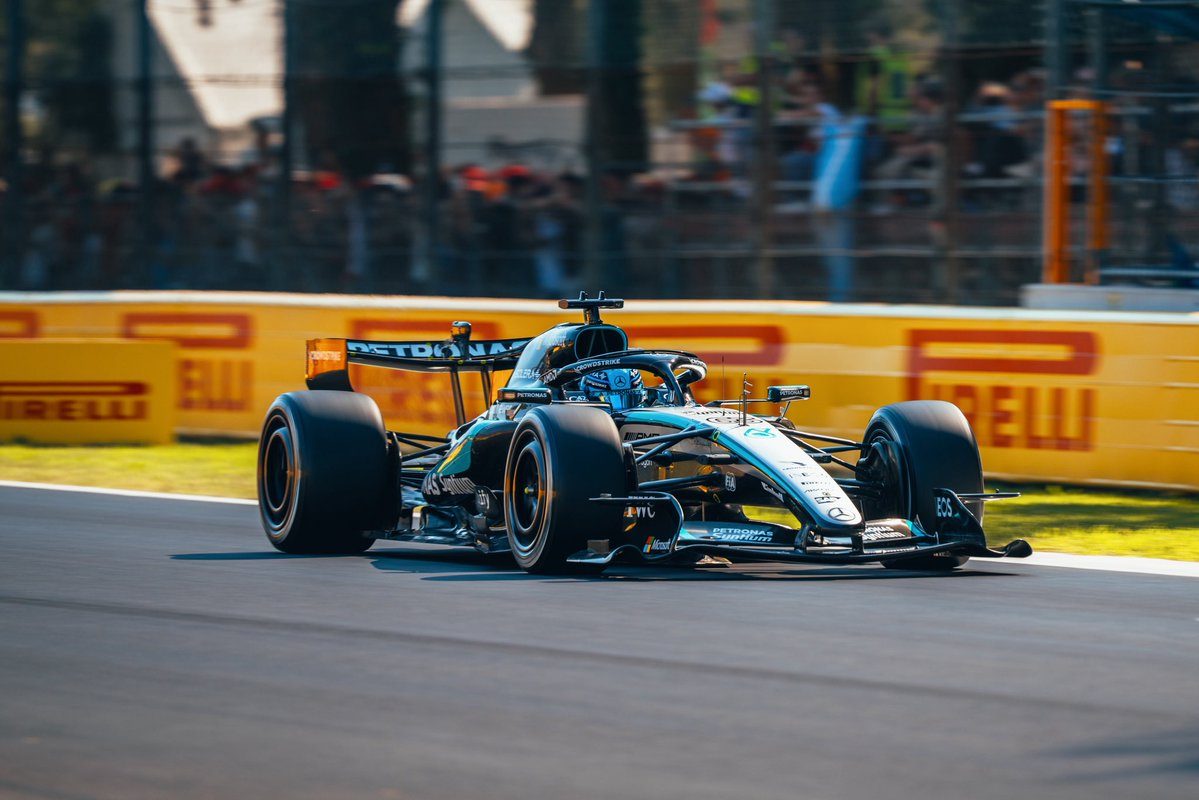
Source: Official Team Post via X
Mercedes Identifies Tyre Temperature as Key Issue in Brazilian GP Struggles
Mercedes has revealed that tyre temperature issues were behind the struggles of Kimi Antonelli and George Russell during the Brazilian Grand Prix. Both drivers felt their cars behaved unusually, which the team attributed to fluctuating tyre temperatures.
Mercedes has shed light on why Kimi Antonelli and George Russell both reported their cars felt "broken" during the Brazilian Grand Prix. The culprit, it turns out, was the W17's tyre temperature, which was "just below the tyre temperature window," leading to "very strange and unusual car behaviour."
In the damp conditions at Interlagos, Antonelli and Russell found themselves unable to keep up with Lando Norris or Red Bull. Although Mercedes showed promising speed at times, Antonelli quickly dropped out of the race-winning mix, and Russell's brief contention was marred by a spin in the pit lane.
Throughout the race, both drivers expressed concerns about their cars' performance. Mercedes' deputy team principal, Bradley Lord, addressed these concerns in a social media debrief. He remarked on the unpredictable nature of the race, noting, "It’s not very often that you spin off on a formation lap and almost make contact with a barrier, that you spin in the pit lane with the other car, that you have several incidents on track as well, and nonetheless manage to come home fourth and fifth."
Lord highlighted that there were phases when Mercedes was the fastest on the track, particularly during the initial inter tyre stint and later with the dry soft tyre. However, Antonelli's earlier spin and flat-spotting of all four tyres hindered his pace.
As for the sensation of a "broken" car shared by both drivers, Lord explained, "We did really struggle as we went onto that dry soft tyre, and then in the final inter stint as well, with a car that was very, very tricky to drive, very oversteery." The low tyre temperatures were to blame, causing the drivers—and even some others in the field—to feel as if something was amiss. In reality, the cars were hovering just below the optimal tyre temperature window, sometimes dipping in and out due to the damp conditions, which led to the peculiar car behaviour.