
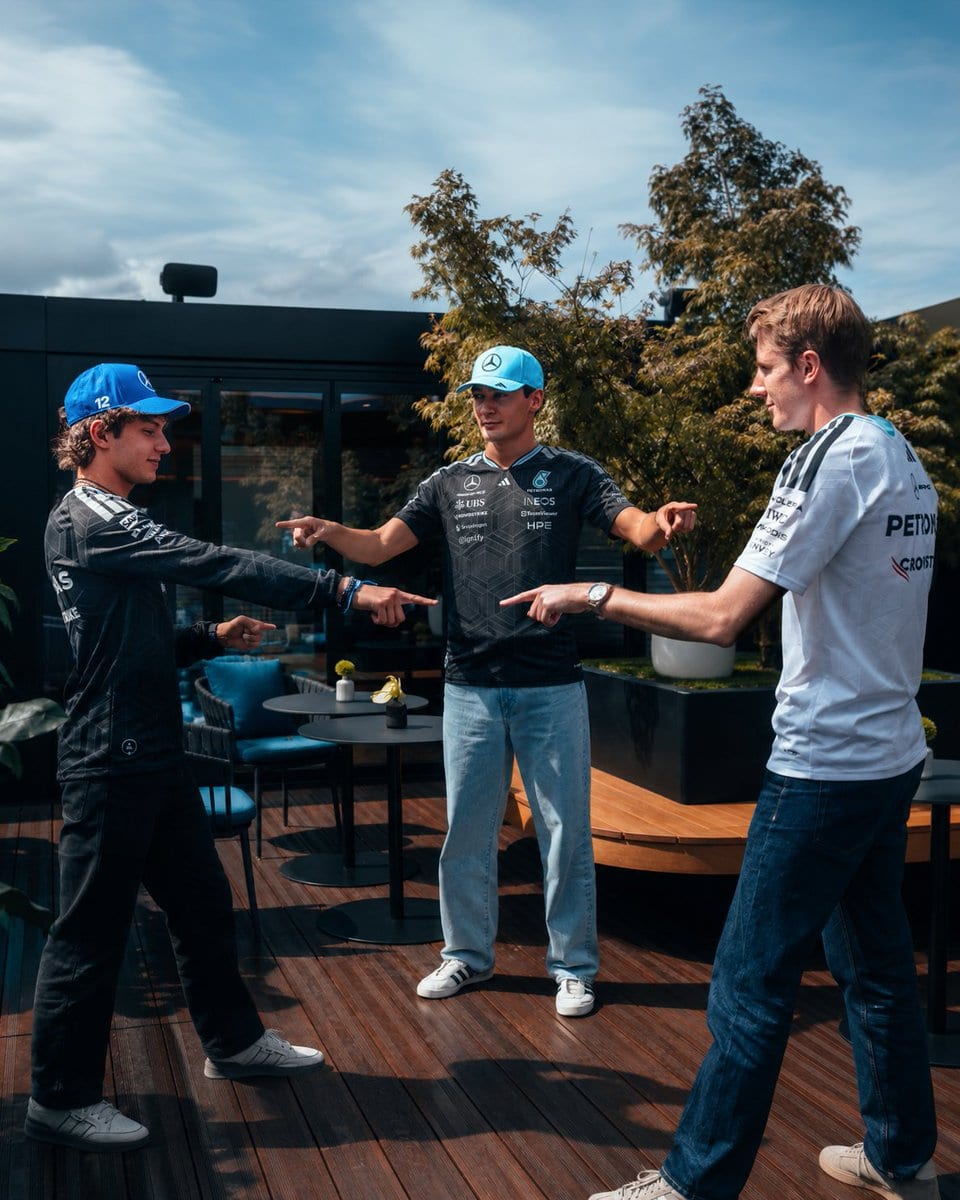
Source: Official Team Post via X
FIA's Yellow Flag Penalty Spurs Driver Debate on Rules Clarity
The FIA's recent penalty for Kimi Antonelli over yellow flag rules has reignited discussions among drivers about what constitutes adequate slowing down. The incident highlights differing opinions on whether a double yellow flag should be standard in such situations.
The age-old debate over Formula 1's yellow flag rules has resurfaced, fueled by a recent penalty handed to Mercedes' Kimi Antonelli. During the Hungarian Grand Prix, Antonelli was hit with a three-place grid penalty for not sufficiently slowing down under yellow flags after Max Verstappen's late Q3 spin. This decision stirred a mix of opinions among the drivers, illustrating a broader divide over how such rules should be enforced.
Just weeks before, Antonelli's teammate George Russell found himself in a similar situation at the Austrian Grand Prix. There, Russell's apparent adherence to the rules allowed him to keep his pole position after lifting at Turn 9 when Verstappen spun. The stewards, after reviewing data, decided Russell had slowed enough, whereas Antonelli, who was further down the track, did not escape penalty despite aborting his lap.
Data analysis by Uros Radovanovic from PlanetF1.com highlighted the discrepancy, noting Russell's time loss was around 0.08 seconds compared to Antonelli's 0.6 seconds. This begs the question of what truly counts as 'sufficient' lifting.
Mercedes' Simone Resta and Bradley Lord, speaking with former F1 driver Anthony Davidson on the team's Nu Silver Arrows Radio Show, delved into the incident. Davidson admitted uncertainty over the stewards' decision, noting Antonelli had lifted earlier than usual, by about 15 meters, and coasted into the corner. Despite this, the stewards ruled the lift insufficient.
Resta pointed out that Antonelli's reference lap was not ideal, complicating the assessment. He argued that even with the lift, Antonelli was being unfairly compared to a slower sector. If compared to practice sessions, where cars carry more fuel and naturally run slower, Antonelli's pace still showed improvement despite the lift.
The regulations leave room for interpretation, making it the stewards' call whether a driver has slowed enough. This has led to suggestions of adopting double waved yellow flags for clarity, but even this proposal has its critics among drivers.
Davidson shared insights from his chat with Russell, who serves as a director of the Grand Prix Drivers' Association. He revealed a lack of consensus among drivers on handling yellow flags during qualifying. Some advocate for automatic double yellows whenever a car stops on track, ensuring uniform understanding across the grid. Others argue this could unfairly penalize drivers not directly impacted by the incident.
Lord acknowledged the stewards' challenge in maintaining consistency, given that no two incidents are identical. Each comes with its unique context, including varying corner speeds and run-off areas. The Mercedes team, like many others, finds itself alternately frustrated or satisfied with these decisions.
Despite the penalty, Antonelli managed to finish third in Hungary, adding 15 points to his championship lead, now 50 points ahead of Lewis Hamilton as the summer break approaches.